CALL US 770-248-9089

7 Tips for Choosing Coffee Packaging Bags

Coffee packaging is no longer a quiet choice made after roasting. It protects aroma, communicates quality, supports freshness, and shapes a buyer’s first impression. The International Coffee Organization reported global coffee consumption of about 177 million 60-kilogram bags in 2022/23. That scale creates intense packaging pressure. Small design decisions can influence waste, shelf life, shipping costs, and customer trust.

This guide presents seven practical tips for selecting Coffe Packaging Bags for roasted beans and ground coffee. It considers barrier performance, material structure, sealing quality, valve design, size, printing, and sustainability claims. The Specialty Coffee Association emphasizes freshness and proper storage as important quality factors. Meanwhile, Smithers’ packaging industry research continues to highlight recyclable structures and responsible material use. These reports offer useful direction, but they do not replace product testing.

Details matter. A thin-looking pouch may fail under warehouse handling. A strong foil laminate may preserve aroma well, yet create recycling challenges. A kraft finish may feel natural, but appearance alone proves nothing. No bag is perfect. That is worth remembering.

Real purchasing decisions should match roast level, distribution climate, filling equipment, and customer expectations. For example, a dark roast shipped through humid coastal warehouses may need stronger oxygen and moisture protection. A local micro-roaster may value low minimum quantities and simple digital printing more than complex laminates. The best Coffe Packaging Bags balance verified performance, practical cost, and credible environmental information. This article helps buyers ask sharper questions before placing an order.
7 Tips for Choosing Coffee Packaging Bags

Understanding Coffee Packaging Requirements

7 Tips for Choosing Coffee Packaging Bags

Understanding Coffee Packaging Requirements

Coffee packaging must protect aroma, freshness, and food safety from filling to final use. The International Coffee Organization reported global coffee consumption at about 177 million 60-kilogram bags in 2022/23. That scale makes small packaging failures expensive.

Choose a bag with strong oxygen and moisture barriers. Roasted coffee releases carbon dioxide after production, so a one-way valve may prevent swelling without admitting excessive air. Ask suppliers for oxygen transmission rate, moisture transmission rate, seal strength, and migration test results. Do not trust appearance alone. A shiny surface proves little. Flexible packaging should also match the filling machine, product weight, and sealing temperature. A narrow seal can split during transport.

Sustainability requires careful trade-offs. The OECD’s Global Plastics Outlook reported that only 9% of plastic waste was recycled globally in 2019. Therefore, evaluate recyclable structures, material reduction, and realistic local collection systems. A thinner bag is not automatically better if it causes more product waste. I have seen teams choose attractive matte films, then discover scuffing and weak seals during handling. That mistake deserves review. Test bags with real roasted coffee, rough cartons, warehouse humidity, and repeated opening. Check valve performance, print durability, lot coding, and consumer grip before approving production. A packaging specification should record every result, not just the successful samples.

Selecting the Right Bag Material and Barrier Properties

Coffee packaging must protect flavor from oxygen, moisture, light, and heat. The USDA Foreign Agricultural Service forecasts 2024/25 global coffee consumption above 170 million 60-kilogram bags. That volume makes packaging performance commercially important. The Flexible Packaging Association reported U.S. flexible packaging sales near $40 billion in 2023. Material selection deserves careful testing, not assumptions.

Tip 1: Match the barrier to the roast. Dark roasts release more carbon dioxide and oils. Tip 2: Check oxygen transmission rate, or OTR. Lower OTR usually protects aroma longer. Tip 3: Measure moisture vapor transmission rate, or WVTR. Humidity can soften roasted coffee and damage texture. Tip 4: Use high-barrier foil when maximum protection matters. It blocks oxygen, moisture, and light effectively. A recyclable mono-material structure may reduce barrier performance. That trade-off needs honest evaluation.

Tip 5: Test the one-way valve with the actual roast. Poor venting can inflate bags or weaken seals. Tip 6: Examine seal integrity after filling, transport, and storage. Tiny wrinkles can create major leakage paths. Tip 7: Request laboratory data, not vague claims. Ask for OTR, WVTR, seal-strength, and shelf-life results. I have seen attractive pouches fail after temperature cycling. Real-world trials still expose mistakes. Packaging choices should reflect distribution climate, roast profile, filling speed, and expected shelf life. A perfect material on paper may perform poorly on a fast production line.

Choosing the Best Bag Size, Shape, and Closure

Choosing coffee packaging starts with the beans, not the artwork. A 250-gram bag suits small households and reduces stale leftovers. For cafés or frequent drinkers, 500 grams offers better value. A one-kilogram format needs strong seals and careful storage after opening. Test the filled bag on a shelf. It should stand without leaning. Bag width also affects shelf visibility, shipping space, and pouring comfort. I once favored a tall, narrow pouch, but it tipped too easily. That mistake was useful.

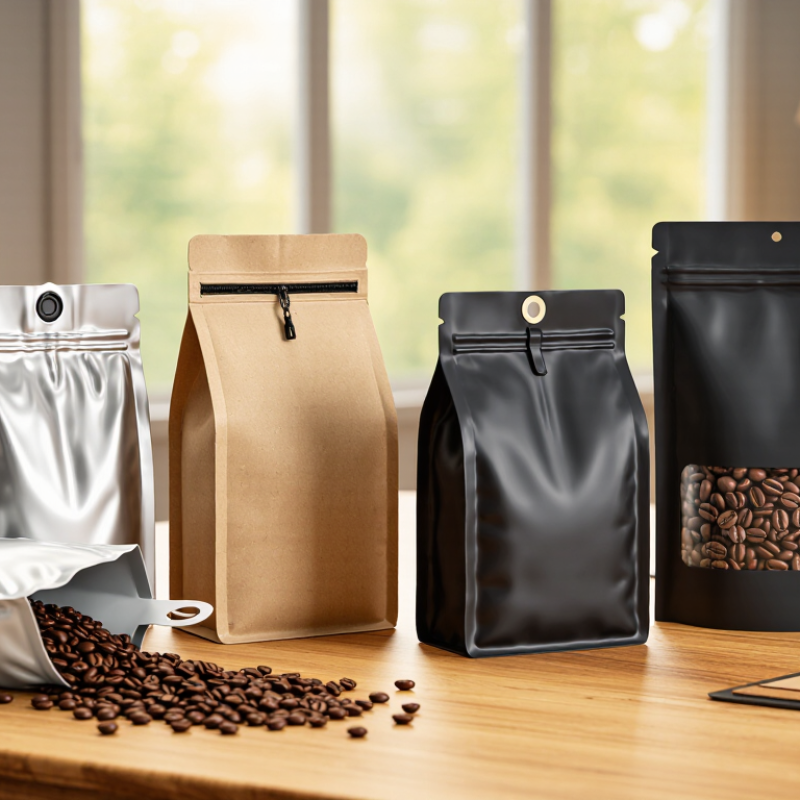
Choose a flat-bottom, side-gusset, or stand-up shape according to use. Flat-bottom bags look stable and display labels clearly. Side-gusset designs hold volume efficiently but may need support. Stand-up pouches are convenient on home counters. Test the opening with one hand. A wide mouth helps scoop whole beans without spills. However, a smaller opening may protect aroma during repeated use. The closure should work smoothly after several openings, not only on day one. A tin tie is simple, but it may not seal as tightly. For freshly roasted coffee, a suitable one-way valve can release gas while limiting air entry.

Ask suppliers for seal strength, barrier performance, and valve testing data. Reliable packaging partners should explain oxygen, moisture, and light protection clearly. Feel the seal edges. Wrinkles near the closure can signal weak sealing or poor filling. Compare samples filled with real beans, not empty mockups. Test opening and reclosing after ten days. Packaging choices are rarely perfect. A cheaper bag may improve margins but frustrate customers if it collapses. A stronger structure may be unnecessary for a short shelf life. Keep notes from every trial.

Evaluating Freshness Features and Product Protection

7 Tips for Choosing Coffee Packaging Bags

Coffee freshness is a packaging problem, not only a roasting problem. Tip 1: Choose a high-barrier laminate with low oxygen transmission. Oxygen dulls aroma and accelerates staling. Tip 2: Check water-vapor transmission, especially in humid warehouses. A dry, secure seal protects ground coffee from moisture. The USDA Foreign Agricultural Service projected 174.9 million 60-kilogram bags of global coffee production for 2024/25. That scale makes repeatable barrier performance essential. Request laboratory data, not vague “premium” claims.

Tip 3: Use a one-way degassing valve for freshly roasted coffee. It releases carbon dioxide while limiting oxygen entry. Valve placement matters. Tip 4: Select an opaque or metallized structure when light exposure is likely. Light can damage aroma compounds over time. The National Coffee Association’s Spring 2024 National Coffee Data Trends report found that 67% of Americans drank coffee during the previous day. Consumers therefore notice stale flavor quickly. Still, valve performance can vary after filling, so test actual production batches.

Tip 5: Examine puncture resistance around gussets and corners. Tip 6: Confirm seal strength under real filling conditions. ASTM F88 testing can support this decision. Tip 7: Trial bags through transport, stacking, and opening tests. A bag may look excellent but fail at the seal. I have found that visual inspection alone is unreliable. That is worth reconsidering. Measure oxygen transmission, moisture protection, and seal integrity before approving the final format.

7 Tips for Choosing Coffee Packaging Bags - Evaluating Freshness Features and Product Protection

Tip Packaging Feature to Evaluate Why It Matters for Coffee Practical Evaluation Criteria Recommended Use
1. Prioritize Oxygen Barrier High-barrier laminate or metallized film structure Oxygen accelerates oxidation, which can reduce aroma and create stale flavors in roasted coffee. Request the supplier’s oxygen transmission rate (OTR), expressed in cc/m²/day, and compare test conditions. Whole beans and ground coffee intended for extended shelf life.
2. Check Moisture Protection Low water vapor transmission rate (WVTR) Moisture can affect coffee texture, aroma stability, and resistance to mold or quality deterioration. Ask for WVTR data in g/m²/day and confirm that the test method and temperature are stated. Humid climates, long-distance shipping, and warehouse storage.
3. Use a One-Way Degassing Valve Pressure-sensitive one-way valve Freshly roasted coffee releases carbon dioxide. A one-way valve allows gas to escape while limiting outside air entry. Verify valve opening behavior, seal integrity, placement, and compatibility with the selected bag material. Recently roasted whole-bean or ground coffee packed before complete degassing.
4. Evaluate Light Protection Opaque or light-blocking inner layer Light exposure can contribute to oxidation and may reduce the stability of coffee aroma compounds. Choose an opaque structure or request light-transmission information when the product will face display lighting. Retail shelves, transparent display areas, and products with longer storage periods.
5. Inspect Seal Performance Strong, continuous heat seals and a reliable zipper where required A weak seal can allow oxygen and moisture to enter even when the film itself has strong barrier properties. Check seal width, seal strength, leak-test results, zipper alignment, and performance after filling. Stand-up pouches, resealable retail bags, and packages handled frequently by consumers.
6. Match Bag Strength to Distribution Appropriate puncture, tear, and compression resistance Abrasion, stacking, and rough handling can damage the package and compromise its barrier system. Conduct filled-bag drop, compression, abrasion, and transport simulation tests for the intended supply chain. Courier delivery, export shipments, warehouse stacking, and larger pack sizes.
7. Select the Right Size and Format Proper headspace, bag dimensions, gusset design, and pack format Excessive headspace increases the amount of oxygen in the package, while an undersized bag can stress seals and seams. Fill sample bags with the actual product, confirm fit, measure net weight, and inspect the finished seal area. Flat-bottom bags, side-gusset bags, stand-up pouches, and single-serve formats.

Note: Barrier performance depends on the complete package system, including film layers, seals, valves, closures, filling conditions, storage temperature, and humidity. Supplier test data should always be reviewed under comparable test conditions.

Balancing Sustainability, Branding, and Packaging Costs

7 Tips for Choosing Coffee Packaging Bags

Sustainability, branding, and packaging costs must work together, not compete blindly. Choose a bag structure that protects roasted coffee from oxygen, moisture, light, and aroma loss. Compare recyclable, compostable, and traditional laminates through verified disposal conditions. A sustainable claim means little if local facilities cannot process the material. Check barrier performance with supplier test data. Ask for migration, seal-strength, and shelf-life reports. Do not rely on attractive certificates alone. Details matter.

Keep branding visible through color, texture, typography, and a clear roast description. Select printing methods that support small batches and reduce setup waste. Standard bag sizes usually lower unit costs, while custom shapes may increase shipping and storage expenses. Request quotes at several order quantities. Calculate the full cost, including filling labor, cartons, transport, and rejected bags. A cheaper film can become expensive after weak seals cause product loss.

Test before committing.

Fill sample bags on the actual equipment. Store them in warm and humid conditions, then inspect seals and valve performance. A practical trial may reveal that a beautiful matte finish scuffs during packing. That is an easy detail to miss. Review customer handling too, because difficult-to-open bags can damage the brand experience. Packaging decisions should be documented with supplier specifications, test results, and realistic disposal guidance. Some compromises are unavoidable, but they should be visible, measured, and reconsidered when evidence changes.