
CALL US 770-248-9089

What Is Carbon Fiber Used For?

Carbon fiber appears in places where low weight and high stiffness matter. You may find it in an aircraft panel, a racing bicycle frame, or a car’s structural component. Its familiar black weave is only part of the story. In many products, carbon fibers are embedded in resin, forming a composite whose performance depends on fiber direction, resin choice, and careful manufacturing. Small details matter.

This article explores what carbon fiber is used for, from aerospace and transportation to sports equipment, construction, and specialized industrial parts. It also explains why designers choose it over metals in some applications, while recognizing that it is not automatically the better option. Carbon fiber can be costly, difficult to repair, and vulnerable to certain kinds of impact damage that may not be obvious from the surface. Recycling remains challenging, too. There is a catch. A lightweight component may still require substantial energy and expertise to produce, so its full value depends on how it is used and maintained. By looking at real applications alongside these trade-offs, readers can understand where carbon fiber offers practical advantages—and where a simpler material may be the wiser choice.
What Is Carbon Fiber Used For?

How Carbon Fiber’s Properties Shape Its Uses

Carbon fiber is valued for its high stiffness and strength relative to its weight. In most products, it is woven or layered into a composite with resin. The fibers carry much of the load, while the resin holds them in place. Direction matters: a panel can resist force strongly along its fibers, yet be less suited to force from another angle. Engineers adjust the layers to match expected stresses.

That tailored performance explains its use in aircraft structures, bicycle frames, sports equipment, and some vehicle components. A lightweight frame can feel responsive without using thick metal tubes. In wind turbine blades, strong, light sections can help manage bending loads. Carbon fiber also resists corrosion, which can be useful in damp environments. Light matters.

The material has trade-offs. It can cost more than metals, and a sharp impact may cause internal damage that is hard to spot from the surface. Repair and inspection need suitable methods. It is tempting to treat carbon fiber as a universal upgrade. That is a mistake. Its performance depends on fiber direction, resin, manufacturing quality, and the forces a part will face; in some designs, a metal part is simpler and more practical.

Carbon Fiber in Aerospace and Aviation

In aerospace and aviation, carbon fiber is used where low weight and high stiffness can improve an aircraft’s performance. The material combines fine carbon strands with a resin, forming a composite that can be shaped into large structural parts. It appears in wings, fuselage sections, tail surfaces, and some helicopter rotor blades. A lighter structure can reduce fuel use, but the benefit depends on the aircraft’s full design.

Carbon-fiber components are built in carefully arranged layers. The direction of each layer affects how the part handles different forces. Some components are cured under heat and pressure, then inspected for flaws. A dent may look minor. Hidden damage can extend beyond what the surface shows, so technicians use approved inspection methods rather than relying on appearance alone. Repairs also require specific materials and procedures.

Aircraft designers must account for impact resistance, lightning protection, and long-term exposure to heat and moisture. Carbon composites resist corrosion, but they are not automatically easier or cheaper to maintain. Metal structures can sometimes be simpler to inspect or repair. That trade-off matters. Carbon fiber is most useful when its weight savings justify the added design, manufacturing, and maintenance demands.

Carbon Fiber in Cars, Trains, and Marine Vessels

Carbon fiber is most useful where engineers need stiffness without carrying unnecessary mass. In cars, it appears in body panels, roof structures, drive shafts, and selected battery enclosures. Less mass can help a vehicle use less energy, though the result depends on design and driving conditions.

The U.S. Department of Energy’s Vehicle Technologies Office reports that a 10% reduction in vehicle weight can improve fuel economy by 6–8%. That estimate covers lightweighting broadly, not carbon fiber alone.

Trains use carbon-fiber composites in components such as interior panels, equipment covers, and some structural parts. Lighter components can reduce the load carried by the vehicle, but they must also tolerate vibration, heat, and repeated service. A lighter part is not automatically a better part. Inspection and repair can be more demanding than with familiar metals, and the full life-cycle benefit depends on manufacturing and end-of-life handling.

At sea, carbon fiber is used in masts, hull sections, decks, and stiffeners, especially where low weight and corrosion resistance matter. A lighter mast can improve balance; a lighter hull may need less propulsion energy at a given speed. But composite damage can be difficult to spot beneath a clean surface. That matters in salt water. The International Energy Agency’s reports on transport decarbonization emphasize efficiency alongside other measures; materials can contribute, but they are only one part of the engineering answer. Practical use still comes down to cost, inspection access, and whether the weight saved justifies the material.

Carbon Fiber in Construction and Infrastructure

In construction and infrastructure, carbon fiber is often used to strengthen structures that are still worth keeping. Crews may bond thin carbon-fiber strips beneath a concrete beam or wrap columns with composite sheets. These additions can help carry loads without adding much weight or bulk. On a bridge, that can mean reinforcing a girder while limiting changes to the roadway below. The work is precise. Surface dust, moisture, and uneven concrete can weaken the bond.

Carbon fiber also resists corrosion, which makes it useful where steel reinforcement is exposed to damp or salty conditions. It can support repairs to parking structures, tunnels, and older buildings. But it does not fix every problem. If concrete is cracked, loose, or poorly supported, the underlying cause needs attention before reinforcement is installed. It is not magic.

Designers must match the material and installation method to the structure, expected loads, and site conditions. Resin curing can depend on temperature, and some systems need protection from fire or sunlight. Inspections matter, too, because a neat surface does not prove the bond is sound. Carbon fiber can extend a structure’s service life, but results depend on careful assessment and workmanship. It is easy to praise the material; choosing not to use it can sometimes be the better engineering decision.

What Is Carbon Fiber Used For? - Carbon Fiber in Construction and Infrastructure

Application Common Carbon-Fiber Form How It Is Used Key Benefit Important Design Consideration
Concrete beam and slab strengthening Externally bonded fabric, sheets, or pultruded laminates Bonded to the tension face of an existing member to increase its flexural capacity; strips may also be applied to improve shear resistance. Provides added tensile reinforcement with relatively little added weight and structural depth. Bond quality, concrete surface condition, anchorage, fire protection, and the possibility of debonding must be addressed in the design.
Column and pier confinement Resin-impregnated fabric wrapped around the member Applied as a continuous or partial wrap around concrete columns, bridge piers, and other structural supports. Confinement can improve deformation capacity and help resist lateral expansion of the concrete under load. Corner rounding, wrap continuity, substrate preparation, and exposure to impact or fire affect performance.
Near-surface-mounted reinforcement Pultruded carbon-fiber bars or strips in shallow grooves Installed in grooves cut into concrete or masonry and fixed with an adhesive or grout system. Places reinforcement within the surface cover, reducing direct exposure compared with externally bonded reinforcement. Groove dimensions, edge distances, adhesive compatibility, and the condition of the surrounding material require checking.
Prestressed concrete strengthening Carbon-fiber plates, tendons, or bars Installed with an applied prestress in selected retrofit systems to help counter existing deflection or reduce tensile stress. High tensile capacity and low mass can make strengthening possible without adding substantial dead load. Prestressing equipment, anchorage zones, long-term losses, and installation quality require specialist design and supervision.
Bridge decks and lightweight structural panels Fiber-reinforced polymer panels or composite laminates Used in selected deck, walkway, or modular panel systems, often with carbon fibers combined with a polymer matrix and other materials. Low weight can simplify transport and installation, while composite construction can provide useful stiffness. Connection details, fatigue, vibration, fire behavior, and the properties of the complete composite system must be evaluated.
Corrosion-resistant reinforcement Carbon-fiber composite reinforcing bars or tendons Used in selected concrete structures exposed to de-icing salts, marine conditions, or other corrosive environments. Carbon-fiber reinforcement does not corrode like conventional steel reinforcement. Composite bars generally do not yield like steel; stiffness, anchorage, bond, and serviceability limits need project-specific checks.
Seismic retrofit of masonry and concrete Fabric, laminates, or composite strips Applied to walls, joints, or structural members to improve selected aspects of load resistance and deformation performance. Can add reinforcement with limited added thickness, which is useful where space or access is restricted. Carbon fiber is directional; layout, continuity, anchorage, substrate strength, and the overall seismic load path are critical.
Infrastructure repair and rehabilitation Bonded fabrics, laminates, or composite wraps Used to strengthen or repair selected bridges, buildings, tunnels, and other concrete infrastructure components. Often allows work to be completed without replacing the entire structural member. It is a strengthening method, not a substitute for diagnosing the cause of damage, repairing unsound material, or meeting inspection requirements.

Note: Suitability and structural capacity depend on the specific fiber, resin, product configuration, installation quality, existing structure, and applicable design standards. Carbon-fiber systems should be selected and designed by qualified structural professionals.

Carbon Fiber in Sports, Consumer Goods, and Industry

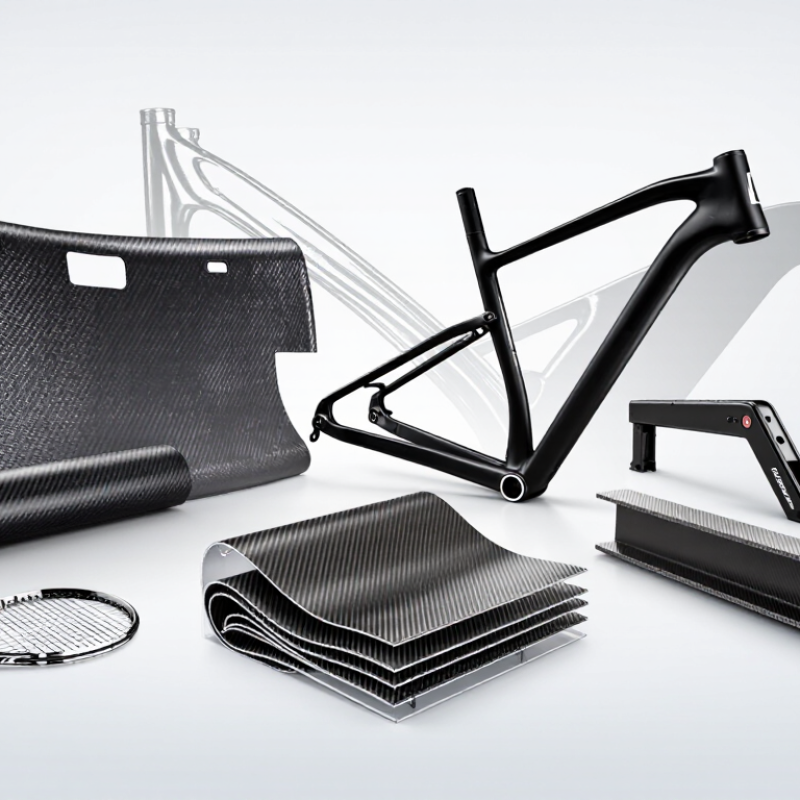
Carbon fiber is valued for its high strength and low weight, but its uses depend on how it is designed and made. In sports, it appears in bicycle frames, fishing rods, tennis rackets, and protective equipment. A well-made frame can feel responsive on a climb, while a thin fishing rod bends under load without feeling overly heavy. That performance has limits. Carbon fiber can crack after a hard impact, and repairs may require specialist knowledge.

Consumer goods use the material in items such as camera supports, luggage parts, and lightweight mobility equipment. Its distinctive woven surface can also be decorative, though appearance alone does not prove quality. In industry, carbon-fiber composites are used in aircraft structures, wind-turbine components, and vehicle parts, where weight reduction can matter. Layers of fiber and resin must be matched to the expected forces. Manufacturing defects are not always visible, so inspection matters. It is easy to assume carbon fiber is always better; sometimes a metal part is cheaper, easier to repair, or more suitable.

Tips: Check the product’s intended use and impact guidance. Look for clear care instructions. After a collision, inspect the part carefully, even if it looks fine. Don’t rely on appearance alone.