What Is a Turf Rake and How Does It Work?
What Is a Turf Rake and How Does It Work?
Turf Rakes are specialized grounds-maintenance tools designed to lift debris, loosen surface material, and refresh grass without aggressive soil disturbance. Unlike a garden rake, a turf rake usually has flexible tines, calibrated spacing, or rotating brushes. These features help it move thatch, dead leaves, clippings, and light moss across delicate turf.
The need is substantial. The National Golf Foundation’s 2023 Golf Industry Report recorded nearly 16,000 golf facilities in the United States. Each facility manages playing surfaces that can suffer from compaction, thatch buildup, and uneven debris. A small rake may appear simple. Its effect depends on tine pressure, operating speed, turf moisture, and grass species.
Dr. Karl Danneberger, a respected turfgrass scientist, offers a useful principle: “The turf tells you what it needs.” That idea should guide every rake pass. If the surface feels spongy, gentle dethatching may help. If the grass tears beneath the tines, the setting is too aggressive.
The USGA Green Section’s turf-management guidance also emphasizes measurement, surface observation, and controlled maintenance. A turf rake does not replace aeration, mowing, or professional diagnosis. It supports them.
Picture a morning fairway. Damp leaves sit between short grass blades. A correctly adjusted rake gathers them cleanly, leaving the canopy upright. Too much pressure exposes soil and creates another problem.
Product descriptions often overstate results. Real performance varies. This guide examines turf rake designs, working mechanisms, suitable applications, and common mistakes. It also considers where the tool helps—and where it should remain in the shed.
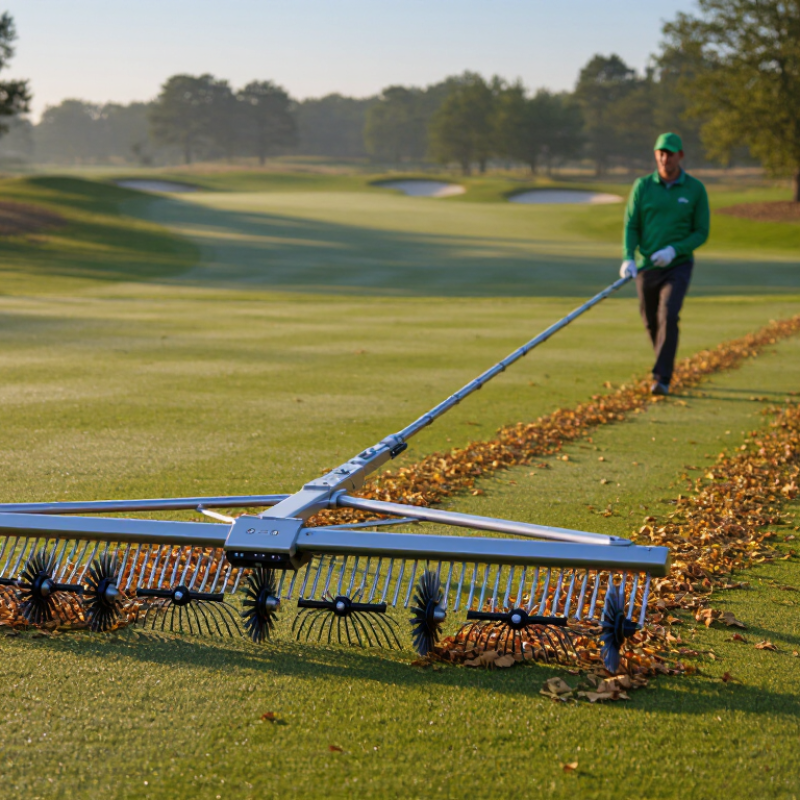
What Is a Turf Rake? Tines, Working Widths, and the ½-Inch Thatch Threshold
A turf rake is a lawn tool that lifts dead stems, shallow roots, and debris from the soil surface. Its tines act like flexible fingers between the grass blades. They loosen thatch without turning the whole soil layer. Some models use spring-steel tines, while others use sturdier fixed teeth. Flexible tines feel gentler. Fixed tines usually remove heavier buildup.
The key measurement is thatch depth. Thatch is the brown, spongy layer between green leaves and the soil. Cut a small square from the lawn, then measure that layer with a ruler. Around ½ inch is a useful warning threshold. A thinner layer can protect roots and reduce moisture loss. A thicker layer may block water, air, and fertilizer from reaching the soil. This is not a perfect rule. Grass type, soil moisture, and lawn stress also matter.
Working width affects control and speed. A narrow rake suits small lawns, tight corners, and spaces near trees. A wider rake covers more ground but can feel awkward around beds and edging. Pull the rake steadily, rather than forcing it downward. I learned this after removing healthy runners with one aggressive pass. Work when the lawn is actively growing and the soil is slightly moist. Dry soil can resist the tines, while wet soil may smear and compact beneath them. Check the surface often. The rake should lift loose thatch, not strip the living crown of the grass.
What Is a Turf Rake and How Does It Work?
A turf rake uses spring tines to lift dead grass, leaves, and thatch from the soil surface. The chart compares representative working widths and the ground area covered during a 100-foot pass.
How to read the chart: A wider rake covers more ground per pass, while a narrower rake offers greater control in tight or uneven areas. A thatch layer around ½ inch is commonly treated as a threshold for considering removal because excessive thatch can interfere with water, air, and nutrient movement.
How Turf-Rake Tines Work: Depth Control and Soil-Surface Contact
A turf rake uses flexible tines to lift thatch, moss, clippings, and loose surface debris. Its performance depends less on force than on tine depth and soil contact. Shallow contact combs the canopy without disturbing roots. Deeper contact cuts through thatch and lightly scratches the soil surface.
Depth should match the turf’s condition. For routine grooming, a tine setting around 2–5 millimeters usually removes debris with limited stress. For heavier thatch, operators may work closer to 6–12 millimeters, but only when the turf is actively growing. The USDA Natural Resources Conservation Service identifies soil penetration resistance near 300 psi, or about 2 megapascals, as a potential restriction to root growth. Excessive tine pressure can create that problem rather than solve it.
Good operators watch the soil, not just the rake. Tines should touch evenly across the head. Uneven contact leaves clean stripes beside untouched patches. Dry soil can make the rake bounce. Wet soil can smear the surface and pull living plants. FAO soil-management guidance also warns that repeated traffic can increase compaction and reduce pore space. I have found that a slightly shallower pass often looks less dramatic, yet protects recovery. That judgment is not perfect. Turf type, moisture, thatch depth, and root strength can change the correct setting within minutes. Test a small area first, then inspect the exposed soil and grass crowns.
When to Dethatch: University Extension Guidance on Annual Timing
A turf rake is a stiff, spring-tined tool that lifts dead grass, runners, and shallow thatch from the soil surface. Unlike a leaf rake, it works vertically and removes the spongy layer that blocks water and nutrients. A thatch layer thicker than 1/2 inch can restrict roots, according to University of Minnesota Extension guidance.
Timing matters more than force. University extension specialists recommend dethatching during active growth, when grass can recover quickly. For cool-season lawns, early fall is usually best, with spring as a weaker alternative. Warm-season turf generally responds in late spring or early summer, after full green-up. Avoid hot, dry periods. A damaged lawn may need several weeks to repair itself. The U.S. Environmental Protection Agency reports that outdoor use represents nearly 30% of household water consumption, so poor timing can create extra irrigation demand. That figure makes recovery planning practical, not cosmetic.
Tips: Cut grass slightly shorter, then rake in one direction. Stop when you see soil, not bare roots. Test a small patch first. If the layer is thin, aggressive dethatching may do more harm than good. I once treated “thatch” as a universal problem, but extension advice suggests checking compaction, mowing height, and drainage first. The 2023 National Gardening Association research report also shows that homeowners increasingly manage lawns themselves, which makes simple depth checks especially valuable. A half-inch ruler and a small soil probe can prevent an unnecessary renovation.
How to Use a Turf Rake: Overlapping Passes and Safe Operating Practices
A turf rake removes thatch, loose clippings, leaves, and shallow surface debris. Its spring teeth or rotating tines disturb the turf lightly, not deeply. The safest results come from slow, overlapping passes. Set the rake for the grass height and soil firmness. Begin with a small test area. If soil appears behind the tines, the setting is too aggressive.
Keep each pass about one-third of the rake’s working width over the previous pass. This prevents missed stripes and uneven thatch removal. Walk or drive at a steady pace, especially near sprinkler heads, curbs, and drainage covers. Shut off the machine before clearing wrapped grass. The U.S. Bureau of Labor Statistics’ 2023 Census of Fatal Occupational Injuries reported a 23.2 fatal-injury rate per 100,000 full-time workers in agriculture, forestry, fishing, and hunting. That figure is not turf-specific, but it reinforces the need for controlled equipment use.
Tips: Wear eye protection, sturdy footwear, and hearing protection around powered rakes. Check the tine condition before every job. Keep bystanders well away from the operating path. Avoid wet soil, because raking can tear healthy roots and leave visible scars. I sometimes make a second light pass instead of forcing one heavy pass. That takes longer, but the turf usually recovers better. Stop if the machine vibrates unusually. Inspect it before continuing.